Not all upholstery fire tests measure the same thing. Some involve a smouldering cigarette, others a small flame or a burning wooden crib. Each presents a different challenge, and passing one test doesn't necessarily mean a material will pass another.
That's why it's important to understand what sits behind a fire rating, rather than relying on the name alone. The test used, the materials involved and the intended setting all affect what that result means in practice.
What does a fire rating measure?
A fire rating describes how a material, or a combination of materials, responds to a defined ignition source under controlled test conditions.
In practice, that means the upholstery is physically tested. A sample construction, made up of the cover fabric and the foam and other materials beneath it, is exposed to a specified ignition source in a laboratory, and the result is assessed against the pass criteria in the relevant standard. The rating is the outcome of that test, not an assumption or a description of what the material is made from.
It is a measure of resistance to ignition, not proof that something is fireproof. No upholstery material should be considered immune to fire simply because it has passed a test. A rating also doesn’t predict how furniture would behave in a real fire. It shows how a particular construction performed against a specific ignition challenge.
Cigarette, match and Crib 5
Different tests use different ignition sources, each representing a different level of challenge.
Cigarette testing (BS EN 1021-1; BS 5852 Ignition Source 0)
A lit cigarette is placed on the upholstery sample and left to smoulder, to see whether it leads to progressive combustion.
Match testing (BS EN 1021-2; BS 5852 Ignition Source 1)
Unlike cigarette testing, this applies a small, direct flame to the sample to assess its resistance to flaming ignition.
Crib 5 (BS 5852 Ignition Source 5)
A small wooden crib is lit on the sample, creating a more demanding flaming challenge. This test is commonly specified for contract and public seating where higher levels of ignition resistance may be required.
These tests are not interchangeable. A construction that passes cigarette and match testing has not necessarily demonstrated that it can withstand a Crib 5 ignition source. The appropriate requirement depends on the intended application and the level of risk associated with the environment.
Why the whole construction matters
A piece of upholstered furniture is built in layers: a cover material on the outside, with foam, an interliner or other backings underneath. In a fire test, it’s these layers together that are tested, not the cover on its own. Each layer can affect how the others respond to the ignition source.
That’s why a result often applies only to the exact combination that was tested. A Crib 5 pass, for example, may relate to a particular covering used over a particular combustion-modified foam. Swap the foam, or add an interliner, and the result may no longer apply, because the construction is no longer the one that was tested.
In practice, this means a covering that passes in one construction can’t automatically be assumed to pass in another. When you review technical documentation, look for more than the standard achieved. It should also state what the covering was tested with, and under what conditions.
A reliable specification links the test evidence to the furniture actually being made, rather than relying on a rating in isolation.
Different spaces, different requirements
A private home, hotel lounge, hospital waiting area and public venue do not necessarily carry the same level of fire risk. The requirements reflect these differences.
Domestic settings
In the UK, upholstered furniture for the home is subject to the Furniture and Furnishings (Fire) (Safety) Regulations 1988, as amended. These regulations establish ignition-resistance requirements for relevant furniture components, alongside applicable labelling requirements.
Non-domestic settings
BS 7176 provides a framework for assessing the ignition resistance of non-domestic upholstered seating, with hazard categories reflecting different levels of risk. Crib 5 is commonly associated with medium-hazard applications, including many commercial interiors.
Transport and marine
These environments can be subject to separate fire testing frameworks and sector-specific requirements, reflecting the conditions in which materials are used.
A familiar rating should not be assumed to apply in every setting. The relevant requirements should be established early, alongside considerations such as comfort, cleanability, durability and appearance.
Looks don’t tell you how it performs
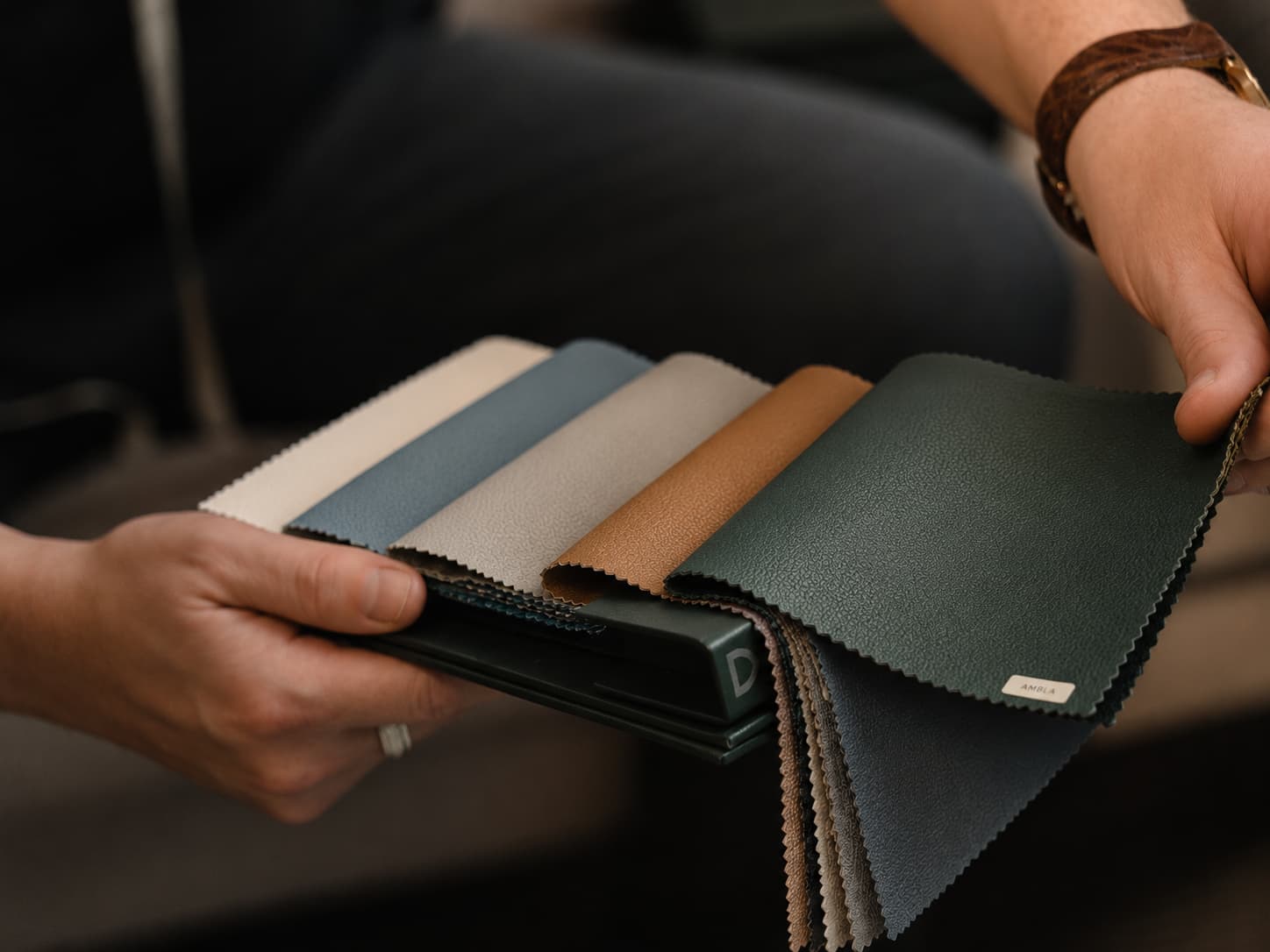
Fire safety doesn’t have to limit your choice of colour, texture or finish. But appearance and fire performance are separate things, and you can’t judge one from the other.
Two coverings can look almost identical and still give different test results. One might be suitable for a public seating specification and the other not.
Checking fire requirements at the start of a project helps avoid unnecessary changes later on. If a material is selected for its appearance before its suitability has been established, it may need to be replaced once the design has already been developed around it.
Questions to ask at specification
With that in mind, before approving an upholstery material, it helps to establish a few important details:
- Which standard and ignition source was the material or upholstery construction tested against?
- Which foam, interliner and backing were used during testing?
- Does the tested construction match the finished furniture? If not, is additional evidence or testing required?
- Is the relevant test report available, rather than relying solely on a certificate or stated rating?
- Which requirements apply to the intended environment, whether domestic furniture regulations, a BS 7176 hazard category or another sector-specific standard?
These questions help establish whether the available evidence supports the intended use of the material.
The Ambla perspective...
Understanding fire ratings doesn’t mean becoming an expert in every test method. It means recognising what a rating covers, what it doesn’t, and whether the available evidence applies to the furniture being produced.
At Ambla, we believe technical performance should be considered alongside colour, texture and finish, not treated as a separate decision. Our experience in developing and manufacturing vinyl-coated fabrics has shaped an approach where material behaviour, durability and design are considered together.
Good specification begins with understanding what a material needs to do, how it has been tested and where it will be used. When those details are clear, safety requirements can be addressed without losing sight of the original design intent.
Want to talk through your project? Whether you’re checking a requirement or choosing a material, get in touch with the Ambla team.