Insights
British-Made upholstery fabric: Does it actually make a difference?
The term ‘British-made upholstery fabric’ is often used as a simple label, but it actually means the material is designed, manufactured, and quality-checked here in the UK.
.jpg&w=3840&q=75)
Here we explain why appearance is only the starting point when choosing the right materials for your project, and what to look for in specifications.
A material can look perfect in a sample presentation and still prove unsuitable for the project.
Appearance remains an important part of any specification. Colour, texture and finish all contribute to the character of a space and help shape how people experience it. Whether the environment is a hotel lounge, healthcare waiting area, workplace interior or transport setting, surface materials influence atmosphere as much as functionality.
But appearance alone rarely determines whether a material is successful.
Commercial interiors place significant demands on upholstered surfaces. Materials may need to withstand frequent use, support regular cleaning routines, comply with fire safety requirements or maintain their appearance over many years. The expectations placed upon them often extend far beyond what can be assessed from a sample alone.
This is where specification becomes more than a design decision.
The most successful material choices are not necessarily those that look best in isolation. They are the ones that continue supporting the needs of the project long after installation has been completed.
Testing is often viewed as a technical requirement, but its real value lies elsewhere.
Performance testing provides a way of understanding how a material is likely to behave in a real environment. Whether assessing durability, flame retardancy, cleanability, colourfastness or hygiene performance, testing helps transform assumptions into evidence.
Without clear evidence, teams have to rely on product claims or past experience. With evidence, decisions are easier to justify, explain, and approve.
Requirements change depending on the setting. A healthcare waiting area has different needs than a restaurant or transport interior. Testing does not make every material right for every use. It helps show where a material fits and where more thought is needed.
Perhaps most importantly, testing provides a common language across a project team.
Designers, contractors, buyers and end users may all approach a material from different perspectives, but evidence allows decisions to be made using the same information rather than individual assumptions.
Before a material arrives on site, it goes through many reviews and approvals. Design teams choose finishes. Technical teams check suitability. Procurement teams look at availability and cost. Contractors need supporting information before installation. Facilities teams later handle care and maintenance.
At each stage, clarity becomes increasingly valuable.
Missing certificates, conflicting product information or unclear care guidance can create delays that have little to do with the material itself. Uncertainty often slows projects more than technical limitations.
Good documentation helps prevent that.
Clear technical information allows decisions to move forward confidently. It reduces the need for repeated clarification and gives everyone involved access to the information they need when they need it.
This is often overlooked, but specification confidence is rarely created by the material alone. It is created by the information that accompanies it.
Many specification challenges can be avoided by asking the right questions before decisions become difficult to change.
Where will the material be used?
Different environments create different demands. Understanding how a space will be used helps establish what performance characteristics are genuinely required.
What evidence supports the specification?
Testing, certification and technical information should support decision-making rather than arrive as an afterthought.
How will the material be maintained?
A material’s long-term performance depends not only on its construction but also on how it is cleaned and cared for once installed.
Can the material be supplied when the project needs it?
Even the most suitable specification can become problematic if availability does not align with programme requirements.
Will the finish remain consistent across the project?
Where multiple seating elements or phases are involved, consistency in colour, texture and performance becomes increasingly important.
Who can provide support if questions arise?
Projects rarely follow a perfectly linear path. Access to informed technical guidance can help resolve challenges before they become delays.
Taken together, these questions help reduce uncertainty and strengthen confidence throughout the specification process.
At Ambla, we believe a performance material should offer more than a convincing sample.
As a British manufacturer of high-performance coated fabrics, we combine design, production, technical development and testing knowledge within a single manufacturing environment. This allows us to maintain consistency across colour, texture, performance and supply while providing clear information to support specification decisions.
For those responsible for selecting materials, confidence often comes from knowing where answers can be found. It comes from understanding how a material has been developed, how it performs and how it can be supported throughout the life of a project.
That is why performance should never be viewed solely through the lens of technical data.
The strongest specifications are built on evidence, clarity and confidence long before a material ever reaches site.
A performance upholstery fabric is designed to meet practical demands such as durability, cleanability, flame retardancy and regular commercial use while still supporting the visual requirements of the interior.
Testing provides evidence of how a material is likely to perform in a specific environment, helping project teams make informed decisions with greater confidence.
Relevant technical data, certification, care guidance, availability information and performance details should all be readily available to support approval and installation.
Clear documentation reduces uncertainty, supports project approvals and helps different stakeholders work from the same information throughout the specification process.
Yes. Performance and aesthetics should work together. A successful specification supports both the visual intent of the project and the practical demands of the environment.
Ambla combines British manufacturing, technical expertise and performance-led coated fabric development to provide clear information, consistent materials and dependable support throughout the specification process.
Thoughtful perspectives on materials, environments and the standards that define them. Where material knowledge meets real-world application across the sectors we serve.
The term ‘British-made upholstery fabric’ is often used as a simple label, but it actually means the material is designed, manufactured, and quality-checked here in the UK.
-1000x605.jpg&w=3840&q=75)
The most responsible material decisions are often the ones nobody notices. Not because they lack impact, but because years later they are still doing the job they were specified to do.
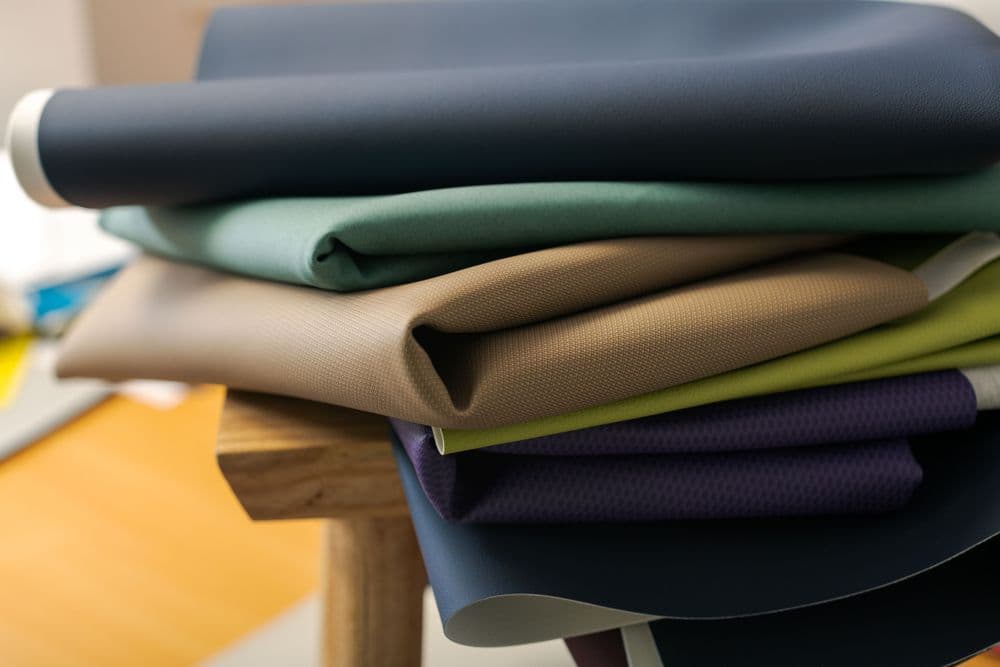
The two most common materials are PU (polyurethane) fabrics and vinyl-coated materials. Both are often called faux leather, which can sometimes cause confusion since the terms aren’t used the same way everywhere.